The Paper
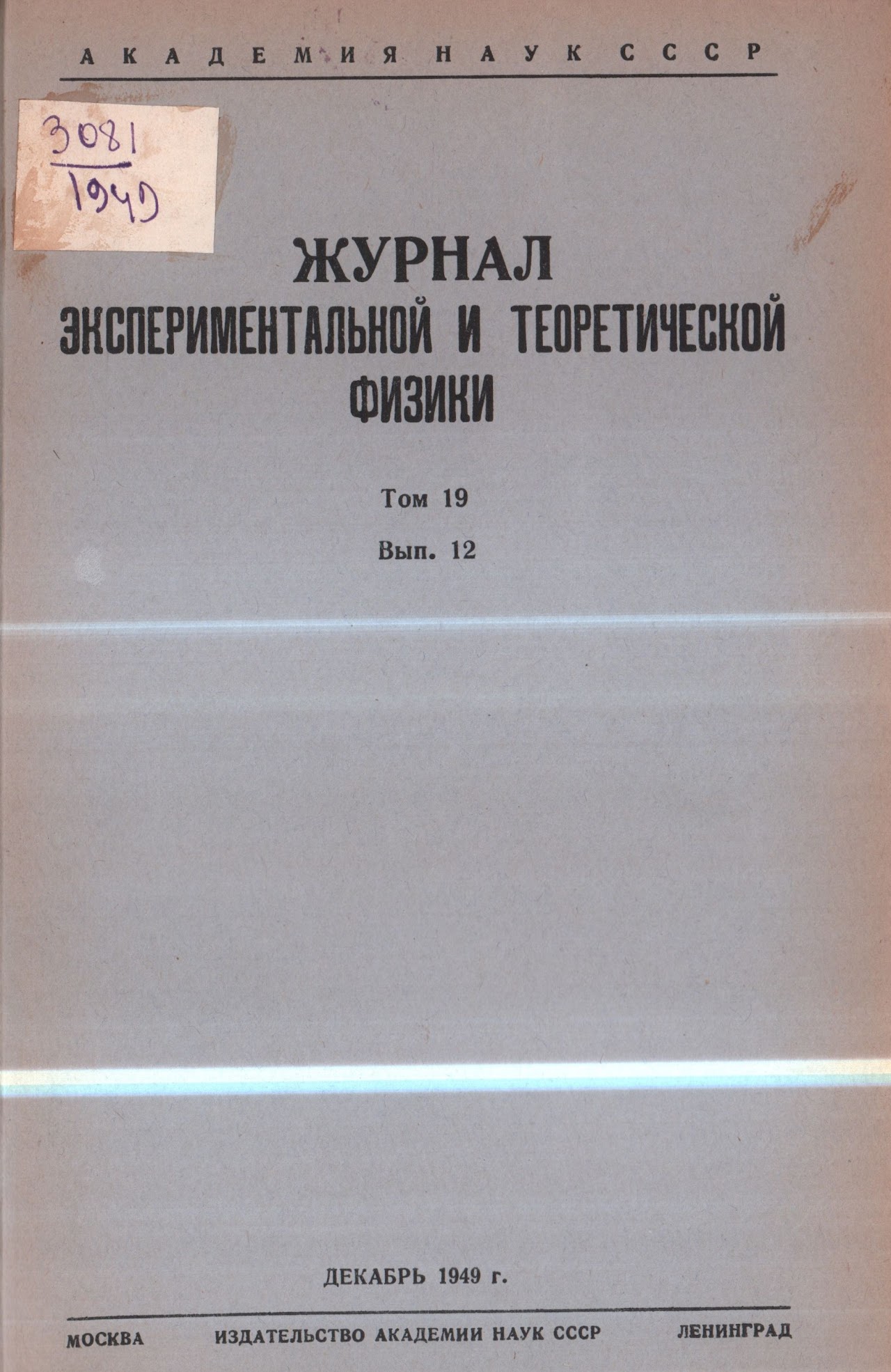
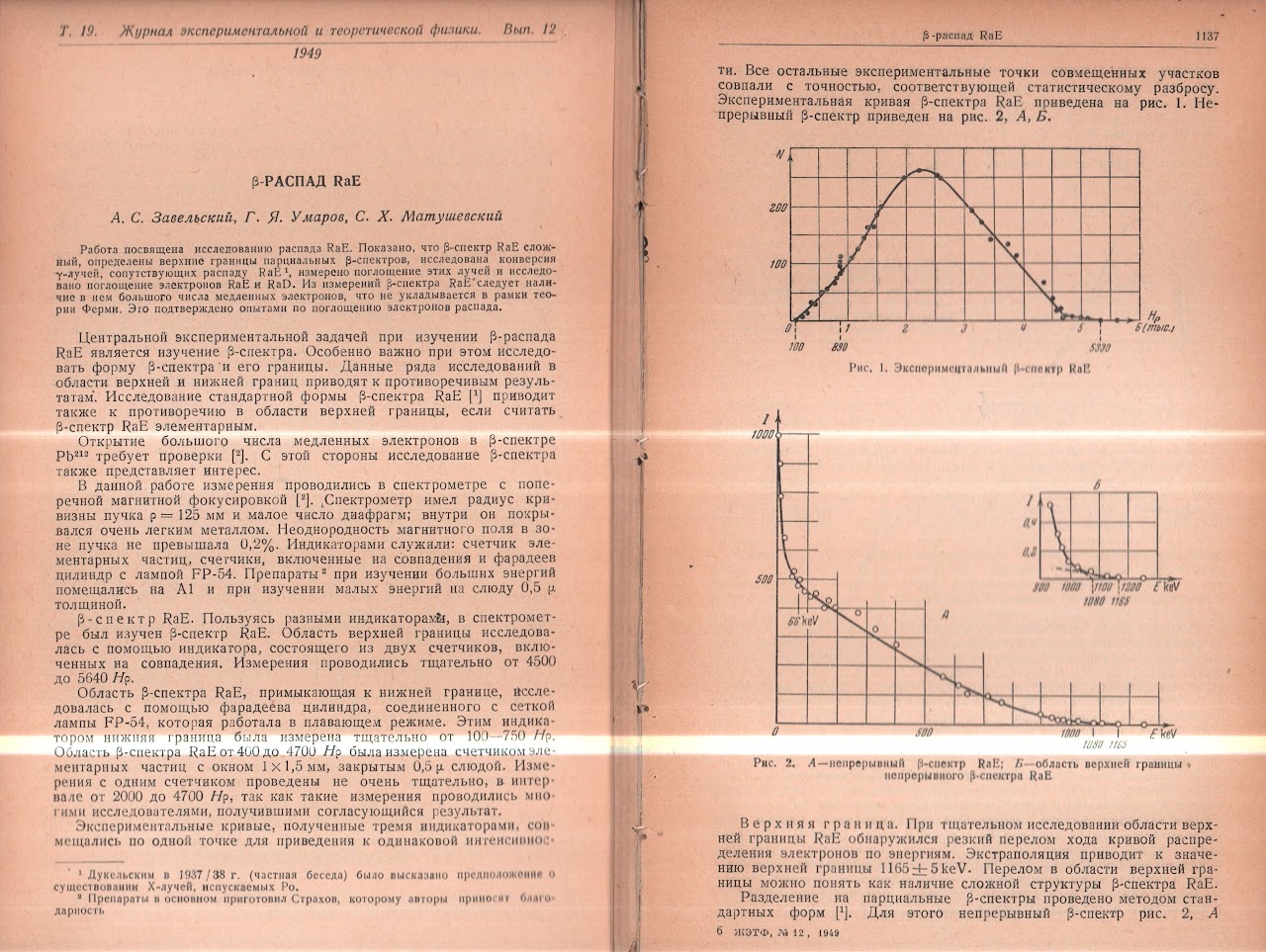
In December 1949, the Journal of Experimental and Theoretical Physics (JETP) published a four-page paper that would quietly reshape our understanding of one of nature's most elusive particles. Titled “β-raspad RaE” (β-Decay of RaE), the article by A.S. Zavelsky, G.Ya. Umarov, and S.Kh. Matushevsky presented meticulous experimental measurements of the beta-spectrum of Radium E (Bismuth-210) — and buried within its data was a conclusion about neutrino mass that was decades ahead of its time.
The paper was received by the editorial board on July 18, 1949 — just months before Umarov's famous dissertation defense at Moscow State University, where he would debate Lev Landau himself over the very same question.
Original Article Scans
The following scans of the original article were kindly provided by the National Library of Georgia.
What the Paper Proved
The experiment used a beta-spectrometer with transverse magnetic focusing (radius of curvature ρ = 125 mm). The researchers measured the complete β-spectrum of RaE (Bismuth-210) with multiple independent detectors: an elementary particle counter, coincidence counters, and a Faraday cylinder with an FP-54 lamp.
Their key findings were:
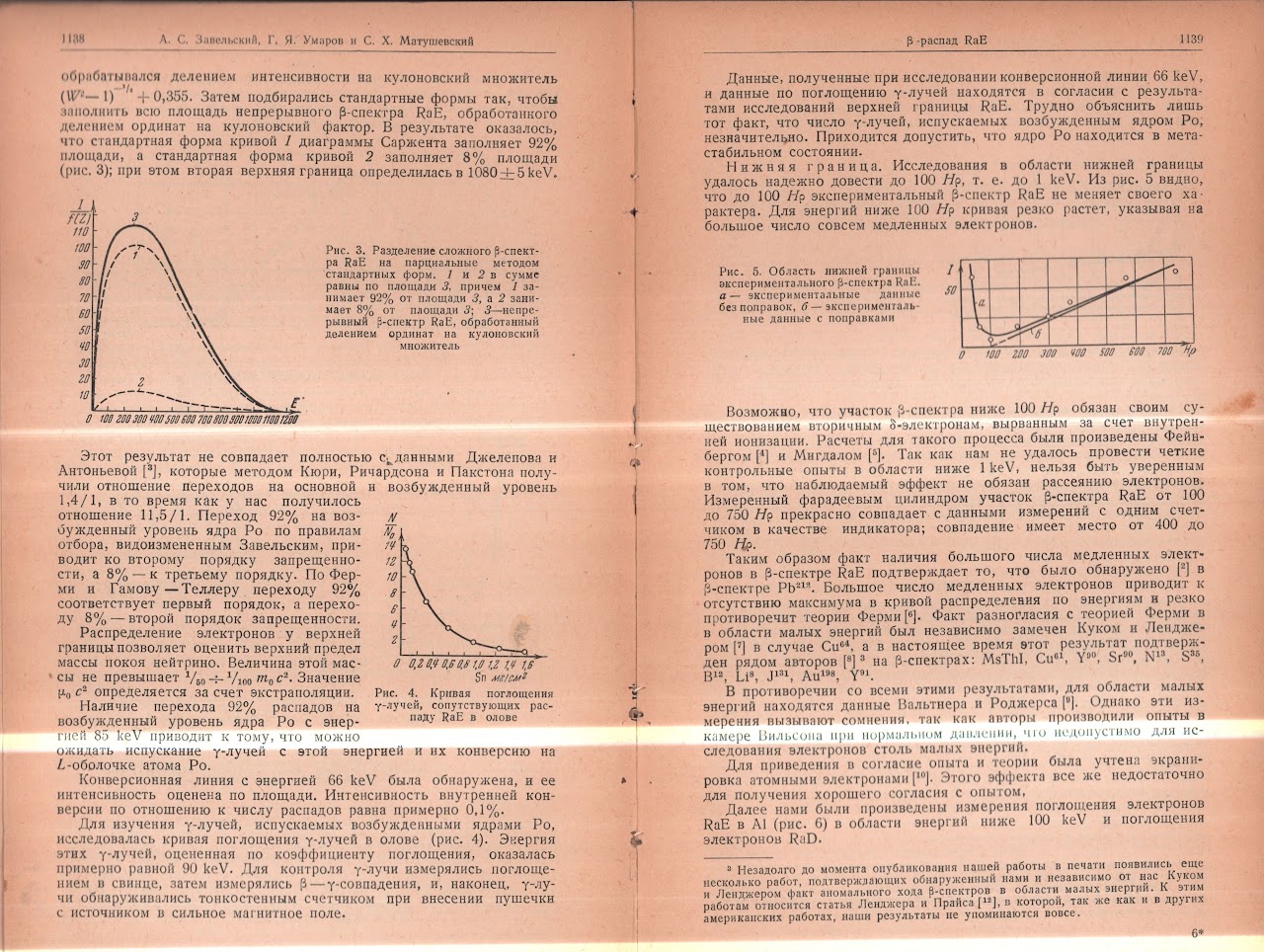
- Complex spectrum: The β-spectrum of RaE is not elementary but complex, composed of at least two partial spectra. The standard Sargent diagram curve 1 accounts for 92% and curve 2 for 8%, with a second upper boundary at 1080 ± 5 keV.
- Upper boundary: The primary upper boundary was determined by extrapolation to be 1165 ± 5 keV.
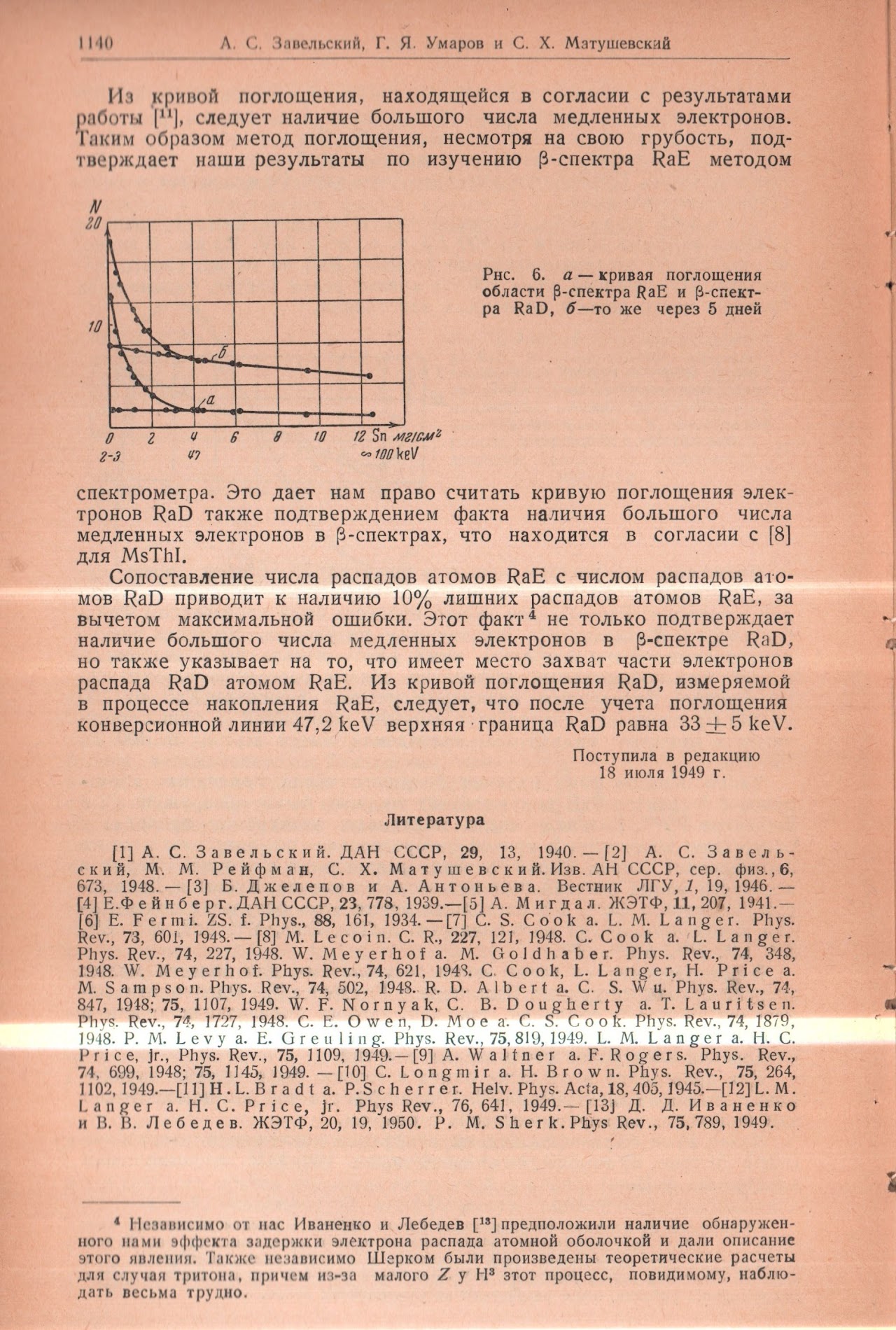
- Slow electrons: A large number of slow electrons was discovered in the β-spectrum, contradicting Fermi's theory and requiring new theoretical interpretation.
- Neutrino mass: From the electron energy distribution near the upper boundary, the authors established an upper limit on the neutrino rest mass: no more than 1/50 to 1/100 of the electron mass (m0c²).
Why This Mattered
In 1949, the prevailing scientific consensus held that the neutrino mass was approximately 0.3 to 0.8 times the electron mass. Umarov and his co-authors’ estimate of 1/50 to 1/100 of the electron mass was radical — it implied the neutrino was far lighter than anyone believed.
This estimate became the centerpiece of Umarov's dissertation defense at Moscow State University, where Lev Landau — the greatest Soviet theoretical physicist — challenged his conclusion. The debate was fierce, but the MSU council voted unanimously (43–0) in Umarov's favor.
“The dissertator remained with his opinion, and the opponent with his.”
— Lev Landau, official review of Umarov's dissertation defense, 1949
Vindication
History proved Umarov right. Modern particle physics has established that neutrino masses are extraordinarily small — on the order of fractions of an electron volt, roughly one millionth of the electron mass. Umarov's 1949 upper bound of 1/50 to 1/100 was far closer to reality than the 0.3–0.8 consensus of his day.
In 1956, the American physicists Clyde Cowan and Frederick Reines achieved the first direct detection of the neutrino. Reines was awarded the Nobel Prize in Physics in 1995 for this discovery — confirming the existence of the particle whose mass Umarov had so accurately bounded seven years earlier.
In 1981, the legendary astrophysicist Ya.B. Zeldovich and M.Yu. Khlopov published a landmark paper on cosmological constraints on neutrino mass in Uspekhi Fizicheskikh Nauk. Their review cited Umarov's early work alongside research by 13 Nobel laureates — a testament to the enduring significance of that 1949 experiment in a Leningrad laboratory.
Citation
“β-raspad RaE” (β-Decay of RaE). Zhurnal Eksperimental'noi i Teoreticheskoi Fiziki, Vol. 19, Issue 12, pp. 1136–1140. December 1949. Received July 18, 1949.